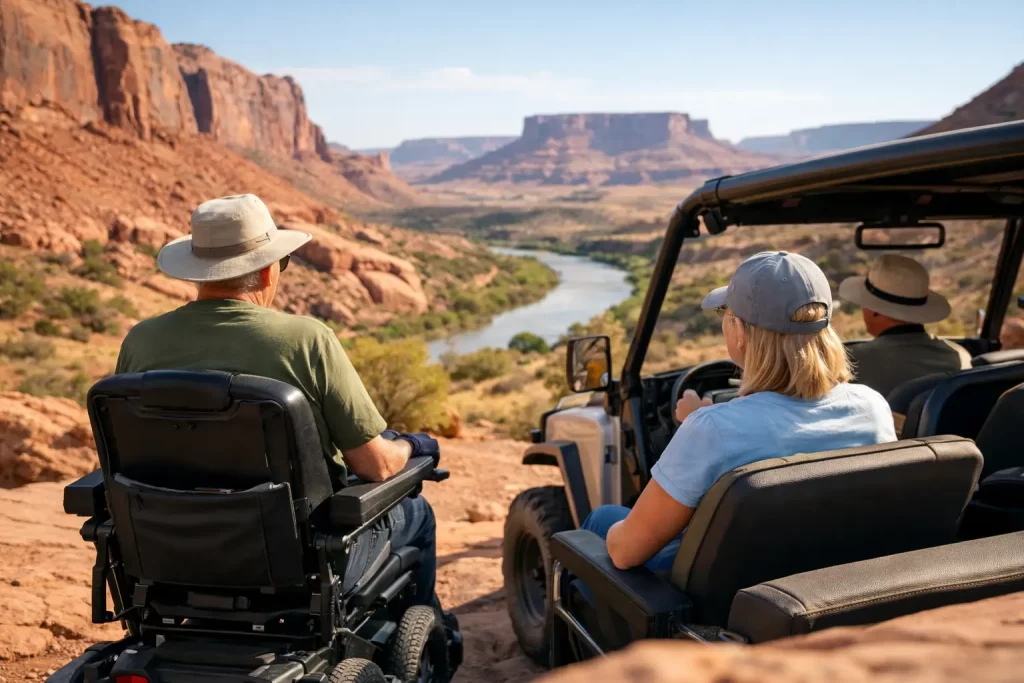
Not every great day in red rock country has to involve steep slickrock, long trail miles, or scrambling over uneven terrain. The best moab tours for limited mobility are built around what matters most here – the views, the stories, the right timing, and a guide who knows how to turn short walks and scenic stops into a full experience.
That matters more in Moab than many first-time visitors realize. This region is spectacular, but it can also be tiring, hot, crowded, and harder to navigate than the brochure photos suggest. Parking fills early, viewpoints vary in accessibility, and even an “easy” stop may include uneven ground, curbs, or short uphill stretches. A well-designed tour makes the difference between seeing a lot from a vehicle and actually feeling included in the landscape.
What makes moab tours for limited mobility worth booking
The simple answer is efficiency with care. A strong limited mobility tour is not just a standard trip with less walking. It should be organized around access, comfort, pacing, and stop selection from the beginning.
That means the route matters. So does the guide. In Moab, the best sightseeing days often come from knowing which overlooks offer the biggest reward for the least effort, when to arrive to avoid crowded parking lots, and how to build in rest without making the day feel slow. Guests who want comfort still want substance. They want iconic arches, canyon rims, desert color, and memorable photo opportunities. They just want them without unnecessary strain.
This is where a premium small-group or private-style approach tends to outperform larger, more generic tours. With fewer people and a more intentional itinerary, the day can move at a pace that feels relaxed rather than rushed. There is more room for flexibility, more time for interpretation, and less chance of spending half the tour waiting on logistics.
What to look for in a limited mobility tour in Moab
Walking distance is the first question, but it should not be the only one. Two tours may both advertise minimal walking, yet feel very different in practice. Surface conditions, step height, time in and out of the vehicle, bathroom access, and the amount of midday exposure all affect comfort.
Ask how much walking is actually expected at each stop, not just the total for the day. A few short walks on flat ground may feel easier than one slightly longer stop on uneven sandstone. It also helps to ask whether the guide can adapt. Some travelers are comfortable with a few hundred yards at a time. Others need very short, scenic pullouts with quick access to viewpoints. Neither is wrong. The right fit depends on the guest, not the label.
Vehicle comfort matters too. In a destination like Moab, where the scenery can be spread across national parks, state parks, and scenic corridors, time on the road is part of the experience. Comfortable transportation, easy entry, and a guide who handles the route planning can make a full day feel manageable instead of fatiguing.
Then there is the question of what kind of experience you want. Some guests want a scenic driving tour with easy walks and plenty of photo stops. Others want to combine multiple parks in one day without taking on strenuous trails. For many limited mobility travelers, the ideal trip is not the shortest one. It is the one that delivers the most meaningful stops with the least physical friction.
Best tour styles for limited mobility travelers
Scenic driving tours are often the strongest fit. In Moab, these can include major highlights in Arches National Park, broad canyon viewpoints in Canyonlands, and dramatic overlooks at Dead Horse Point State Park, all with relatively little walking. The value is not simply that you stay in the vehicle more often. It is that a well-built scenic itinerary still feels full.
Half-day tours can be excellent for guests who want a lower-energy outing or who do better with a shorter commitment. They leave room for a relaxed lunch, a rest break at the hotel, or a second activity later in the day. For some travelers, especially retirees or guests managing pain, stamina, or heat sensitivity, this is the smartest choice.
Full-day tours work well when they are paced correctly. A thoughtfully organized day can cover more ground, reduce the need for separate park planning, and give visitors a better feel for the region as a whole. If your goal is to make the most of a short trip to Moab, this can be the highest-value option, provided the operator has clearly defined the walking level and keeps the day flexible.
Sunset tours also deserve attention. Evening light is softer, temperatures are often more comfortable, and the scenery becomes even more dramatic. For guests who want a memorable, lower-stress outing without the intensity of a midday schedule, sunset can be a very good fit.
The trade-offs to think through before you book
There is no single best answer for every traveler. It depends on mobility level, heat tolerance, transfer ease, and how much sightseeing you want in one outing.
A larger bus tour may cost less, but it often comes with less flexibility and less personal attention. If you move more slowly, need extra time getting in and out, or want more help understanding what to expect at each stop, a smaller group usually gives you a better day. You are not just buying transportation. You are buying execution.
Private-style experiences also have an advantage when mobility needs are specific. Maybe one traveler wants only very short walks, while another in the same party is comfortable doing a bit more. Maybe timing matters because of medication, energy level, or avoiding peak heat. That is much easier to handle with a guide and itinerary built around real people instead of a fixed bus schedule.
At the same time, some guests overestimate what they want to cover. Moab rewards restraint. If you try to squeeze in too much, even easy stops can start to feel tiring. A slightly shorter itinerary with better stop quality often feels richer than a packed schedule with constant transitions.
Why scenic access still feels like a real Moab experience
Some travelers worry that if they are not hiking deep into the parks, they are only getting a partial version of Moab. That is understandable, but it misses something essential about this landscape. Many of the region’s most powerful moments come from the road, the rim, and the viewpoint.
The contrast of red rock towers against blue sky, the immense drop at Dead Horse Point, the layered canyons stretching beyond sight, the changing color at golden hour – these are not lesser experiences. They are central to why people travel here in the first place. A good guide adds depth by connecting those views to geology, history, desert ecology, and the human stories of the region.
That is why limited mobility tours should never feel like a consolation prize. Done well, they are not about what gets removed. They are about what gets prioritized. You are still seeing signature landscapes. You are still getting standout photos. You are still learning the place from someone who knows how to read it.
Questions to ask before reserving
Before booking, be direct about your needs. Ask about walking surfaces, step-in height, restroom timing, and how often guests get in and out of the vehicle. If you use a cane or walker, say so. If you can manage short walks but not stairs or uneven slickrock, say that too. Specific information leads to a better recommendation.
It is also smart to ask how the day is paced. A tour that includes more stops is often a better value, but only if those stops are organized well. The strongest operators know how to balance major sights with comfort, avoiding wasted time while still leaving room to enjoy the moment. Companies such as Moab In A Day have built their reputation on exactly that kind of thoughtful itinerary design for travelers who want to see more without taking on more stress.
Finally, ask what the experience feels like, not just what it includes. That answer usually tells you whether the company understands limited mobility guests as an afterthought or as a core part of the audience.
A great Moab day does not depend on how far you walk. It depends on whether the tour is organized with enough care to bring the landscape within reach, comfortably and well.