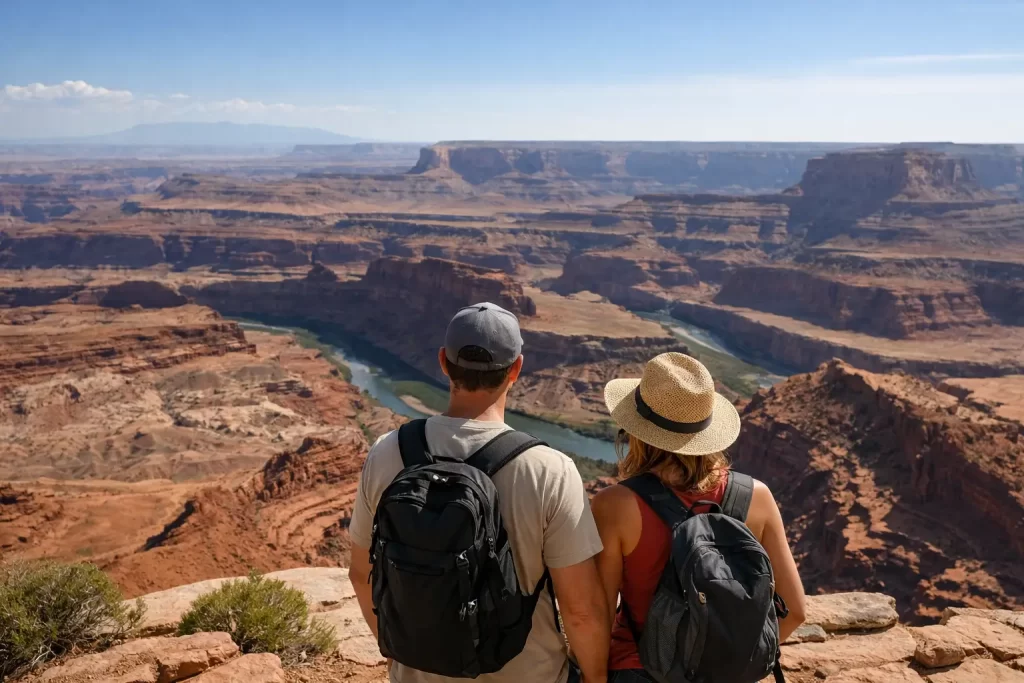
You can drive to Dead Horse Point, step out at the rim, and still miss what makes the place unforgettable. A well-run dead horse point tour turns a beautiful overlook into a fuller Moab experience – one where timing, stop selection, and local context make the view feel even bigger.
This is one of those parks that looks simple on a map and richer in person. The main draw is obvious: a dramatic canyon bend where the Colorado River loops through layers of red rock nearly 2,000 feet below. But the real question for most travelers is not whether Dead Horse Point is worth seeing. It is how to see it in a way that fits your trip, your energy level, and the rest of what you want from Moab.
Why a dead horse point tour works so well
Dead Horse Point State Park is compact, scenic, and easy to pair with nearby highlights. That sounds straightforward, but it also means small decisions matter. The right departure time changes your light and your crowd level. The right sequence of stops can give you wide-open viewpoints, short walks, and meaningful interpretation without making the day feel rushed.
For first-time visitors, that structure is the difference between a stop and an experience. You are not just checking off a viewpoint. You are seeing how this park connects to Canyonlands, the Colorado River corridor, local geology, and the broader story of the Moab desert.
A guided tour also removes the usual friction points. You do not need to puzzle through entrance logistics, wonder which overlooks are best, or guess how much walking a trail actually involves. That matters for couples trying to fit a lot into one day, families managing different energy levels, and retirees who want comfort without settling for a watered-down outing.
What you actually see on a Dead Horse Point tour
Most visitors know the postcard overlook, and yes, it deserves the attention. Dead Horse Point Overlook is the anchor stop because it delivers one of the most famous views in Utah with very little effort. The perspective is broad, dramatic, and easy to appreciate whether you are a serious photographer or just someone who wants that one frame that makes friends back home say, where is that?
But a good tour does not treat the overlook as the whole park. Depending on the itinerary and walking level, you may also visit additional rim viewpoints, short scenic trails, and pullouts that reveal different angles of the canyon system. That variety matters because Dead Horse Point changes with each shift in elevation, sun angle, and direction of view.
Some tours lean more scenic and accessible, with easy walks and frequent stops. Others add more trail time for guests who want to stretch their legs and spend less time in the vehicle. Neither approach is automatically better. It depends on your group, the season, and whether Dead Horse Point is your main destination or one part of a larger Moab day.
Scenic driving tour or walking-focused tour?
This is where travelers often make the smartest choice by being honest about pace. If your priority is seeing the biggest landscapes with minimal strain, a scenic driving format is a strong fit. You still get excellent views, quality photo stops, and interpretive storytelling, but the day stays comfortable and efficient. For limited-mobility travelers, multigenerational groups, or anyone visiting in summer heat, this can be the right call.
If you enjoy easy to moderate walking, a more active format can add texture to the experience. Short rim trails give you space to absorb the scale of the place away from parking lots and quick-stop crowds. You notice details – the color bands in the cliffs, the changing shape of distant buttes, the way the river sits deep in the landscape rather than announcing itself all at once.
The trade-off is simple. More walking usually means fewer total stops or a narrower regional scope. If your goal is to combine several major parks in one day, too much hiking can limit what fits comfortably into the schedule.
Timing changes everything
Dead Horse Point is good at almost any hour, but not equally good. Midday can flatten the light and bring more traffic, especially in peak travel periods. Morning often feels calmer and clearer, while late afternoon and sunset bring warmer tones and longer shadows that make the canyon walls stand out.
That does not mean sunset is always best for every traveler. If you are trying to combine Dead Horse Point with Arches or Canyonlands in a single day, a tightly organized daytime itinerary may make better use of your time. If photography is your top priority, or if you want a more relaxed, single-focus outing, a sunset-centered experience can be worth it.
Season matters too. Spring and fall usually offer the easiest conditions. Summer can still be excellent, but comfort planning matters more, especially for guests who are sensitive to heat. Winter has its own appeal – fewer crowds, crisp visibility, and occasional snow contrast on the red rock – though temperatures can be cold and conditions may shift quickly.
How Dead Horse Point fits into a bigger Moab itinerary
One of the strongest reasons to book a guided experience is that Dead Horse Point works exceptionally well as part of a broader regional tour. It sits near Canyonlands Island in the Sky, which means guests can often pair both in a single outing without wasting time backtracking.
That pairing makes sense. Dead Horse Point gives you one of the region’s most iconic singular views, while Island in the Sky expands the story with mesa-top overlooks, deep canyon panoramas, and a bigger sense of the district’s geography. Together, they create a fuller day without feeling repetitive.
For travelers with limited time in Moab, this kind of itinerary design is where professional planning pays off. You want enough stops to feel complete, but not so many that the day turns into a blur. The best tours strike that balance carefully. They know where to linger and where to keep moving.
What to look for when choosing a tour
Not all Dead Horse Point experiences are built the same, even when they sound similar online. The first thing to check is walking intensity. Terms like easy or moderate can mean very different things depending on the operator, so look for specifics on trail distance, footing, and how much time is spent on your feet.
Group size matters just as much. Smaller groups usually move faster, adapt more easily, and feel more personal. That can mean better photo timing, more room for questions, and less waiting around at every stop. If you want something close to private-style touring without the cost of a fully private trip, small-group formats often hit the sweet spot.
It is also worth looking at stop quality, not just duration. A four-hour tour with excellent viewpoint selection and smart pacing can outperform a longer itinerary that spends too much time loading, unloading, and covering unnecessary ground. In Moab, route design is not a minor detail. It is the experience.
Guide quality is the other major separator. A strong guide does more than point at scenery. They help you read the landscape, understand what makes each stop distinct, and adjust the day to weather, energy, and crowd patterns. That local judgment is hard to overstate.
Who gets the most value from a guided Dead Horse Point tour
First-time Moab visitors usually benefit the most because the region is visually dense. There is a lot to see, and the difference between a good day and a great one often comes down to order, timing, and context. If you only have a day or two, having someone else handle those decisions can save a surprising amount of energy.
Guided touring is also a strong fit for travelers who want comfort without giving up substance. That includes older guests, visitors with limited mobility, and anyone who would rather spend the day looking out the window than checking maps and parking conditions. Done well, the experience feels easy but never generic.
Even active travelers often find value in a guided format when the goal is efficiency. If your trip includes several parks, a structured itinerary helps you see more without drifting into decision fatigue. That is one reason many guests choose companies like Moab In A Day – they want the region’s biggest highlights with better organization, more meaningful stops, and none of the guesswork.
A few practical expectations before you go
Bring water, sun protection, and layers even if the forecast looks mild. High-desert weather can shift fast, and exposed viewpoints feel warmer or colder than expected depending on wind and season. Comfortable walking shoes are usually enough for most scenic tours, but trail-specific outings may call for more support.
Do not expect every stop to be strenuous. One of the strengths of Dead Horse Point is that it delivers major scenery with relatively low effort. That makes it accessible to a wide range of travelers. It also means the quality of the tour comes from pacing, interpretation, and stop selection more than sheer physical challenge.
If you are deciding whether to carve out time for this park, the answer is yes for most Moab itineraries. Dead Horse Point gives you one of the cleanest, most powerful views in the region, and when it is paired with the right guide and the right rhythm, it becomes more than a scenic detour. It becomes the moment in your trip that puts the whole landscape into perspective.