
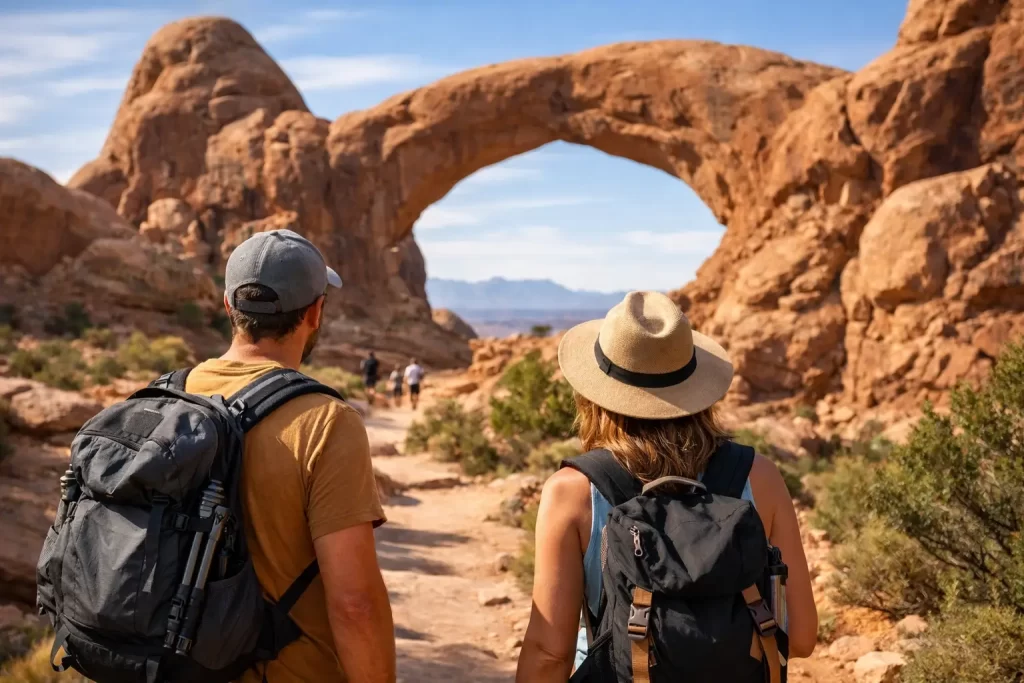
You do not need to sprint through Arches National Park to have a great day there. You need a plan that matches the way the park actually works. If you are wondering how to see arches efficiently, the answer starts with timing, stop selection, and knowing where people lose time without realizing it.
Arches looks simple on a map. One main road, famous viewpoints, a few headline hikes. In practice, visitors burn hours at the entrance line, circle full parking lots, overcommit to long hikes in midday heat, and spend too much energy deciding what to do next. A better day feels calmer. You see more, walk the right amount for your group, and still have time to enjoy the landscape instead of chasing it.
How to see arches efficiently starts before you arrive
Efficiency in Arches begins before your tires hit the pavement. The park is popular for a reason, and that popularity changes the math. Entry timing, season, fitness level, and heat tolerance all affect what a realistic day looks like.
If you are visiting in spring or fall, expect the biggest crowds and the most parking pressure. Summer brings extreme heat, which can shorten what many people are actually willing to hike. Winter is quieter, but daylight is shorter and weather can shift fast. There is no single perfect season, only the season that fits your priorities.
The best way to save time is to decide in advance what kind of day you want. Do you want the greatest number of iconic overlooks with easy walks? Do you want one major hike plus scenic stops? Are you traveling with kids, older parents, or someone who prefers a mostly driving-based experience? Those are not small details. They determine whether your plan works or unravels by late morning.
Build your day around zones, not random stops
One of the easiest mistakes in Arches is treating every landmark as a separate mission. The smarter approach is to move through the park in a logical sequence and enjoy clusters of stops rather than zigzagging based on impulse.
From the entrance, you will naturally pass major viewpoints and trailheads as the road climbs into the park. That means your day should usually flow in one direction with limited backtracking. Start with your priority stop, then work back through the secondary stops that fit your energy and available time.
For many visitors, the far end of the park deserves early attention. If Delicate Arch Viewpoint, Devils Garden, Landscape Arch, or Double O Arch matter to you, getting deeper into the park first often helps you beat some of the congestion that builds later. Then, on the way back out, you can stop at windows, balanced rocks, and viewpoints with shorter walks.
This is where efficient planning beats ambitious planning. You are better off doing six great stops in a smart order than trying for ten and feeling rushed all day.
Choose one anchor experience
A strong Arches itinerary usually has one anchor. That might be the full Delicate Arch hike, the easier Devils Garden walk to Landscape Arch, a photography-focused scenic drive, or a mix of viewpoints designed for limited mobility.
Once that anchor is set, the rest of the day becomes easier to shape. If your anchor is a longer hike, keep the other stops short and scenic. If your anchor is a comfort-first driving tour, add several easy walks without overloading the day. If you skip this step, every stop starts competing with every other stop.
Match the route to your walking level
This matters more than people expect. Arches can be very friendly to visitors who want easy access to big views, but it also includes trails that feel much longer in sun, wind, and slickrock than they sound on paper.
A couple in their 30s with hiking shoes and a winter start can cover very different ground than grandparents traveling with grandkids in July. Neither group is doing it wrong. The efficient plan is the one that respects real pace, bathroom breaks, snack stops, and the simple fact that scenic travel is supposed to be enjoyable.
The biggest time traps in Arches
If you want to know how to see arches efficiently, it helps to know where the day usually goes sideways.
The first trap is arriving too late. Mid-morning is when entrance delays and packed parking areas begin stealing time. An early start gives you more choices, cooler temperatures, and a less hurried feel at the most popular stops.
The second trap is underestimating parking friction. In Arches, a five-minute stop can become a 25-minute event if you have to wait for a space. That is especially true at signature trailheads and major viewpoint areas. If a lot is full, it is often smarter to pivot to your next stop and return later than to sit in a line of idling cars.
The third trap is stacking too many long walks together. Visitors often plan Delicate Arch, Devils Garden, and several other walks on the same day without factoring in heat, recovery time, and the drive between them. On paper it looks efficient. On the ground it often becomes exhausting.
The fourth trap is ignoring the rhythm of the light. If photos matter to you, when you visit a stop can matter almost as much as which stop you choose. Harsh midday light flattens the stone and makes even famous landmarks feel less dramatic. Early and late light usually rewards a slower pace.
A realistic one-day strategy for first-time visitors
For most first-time visitors, the most efficient day in Arches is not the hardest day. It is a day built around highlights that give you variety – scenic overlooks, iconic rock formations, one meaningful walk, and enough margin to enjoy the place.
Start early and go in with your first major stop already chosen. If you want one moderate hike, do it before the hottest part of the day. Then shift to easier scenic stops and short walks. Save flexibility for the return through the park, because that is where you can adjust based on parking, weather, and energy.
A solid first-timer day often includes a scenic introduction near the front of the park, one deeper priority area, and a return through the Windows section and other roadside viewpoints. This gives you a broad feel for Arches without spending the whole day in a rush from trailhead to trailhead.
If you are traveling with mixed abilities, scenic driving paired with a few carefully chosen short walks is often the best answer. You still see extraordinary terrain, and no one feels like the day was designed for someone else.
Guided touring vs. doing it yourself
There is a reason so many visitors look for help with Arches once they realize how much there is to coordinate. The park rewards local knowledge. A guide can help with pacing, route order, interpretation, photo timing, and practical details that first-time visitors usually learn only after losing time.
That does not mean self-guided travel is a bad idea. If you enjoy planning, start early, and are comfortable adjusting on the fly, you can absolutely have a great day on your own. But if your trip to Moab is short, or if you want to combine ease with substance, guided touring often becomes the more efficient option.
A well-designed tour should not feel like a rigid bus schedule. It should feel like someone else handled the complicated part so you can focus on the scenery, the geology, the stories, and the experience itself. That is especially valuable for travelers who want to see a lot without constantly checking maps, trail distances, and parking conditions. For guests looking for that kind of day, Moab In A Day is built around exactly this style of efficient, high-value touring.
How to see arches efficiently without missing the point
Efficiency is useful, but there is a limit. If your entire day becomes a checklist, Arches starts to feel smaller than it really is. The park is not just a set of photo stops. It is texture, silence, changing light, and strange geology that takes a moment to appreciate.
The best itinerary has structure, but it also leaves room. Room to linger at a viewpoint. Room to let a shorter walk turn into the memory of the day. Room to hear the story behind the stone instead of just snapping a picture and moving on.
That is the balance worth aiming for. See the major arches and viewpoints. Move through the park in a smart order. Start early, plan honestly, and match the day to your group instead of some imaginary ideal traveler. When you do that, Arches feels less like a race and more like what you came for – one of the most memorable landscapes in the American West, experienced well.